The History of the ‘Ville
How Louisville Came to Be
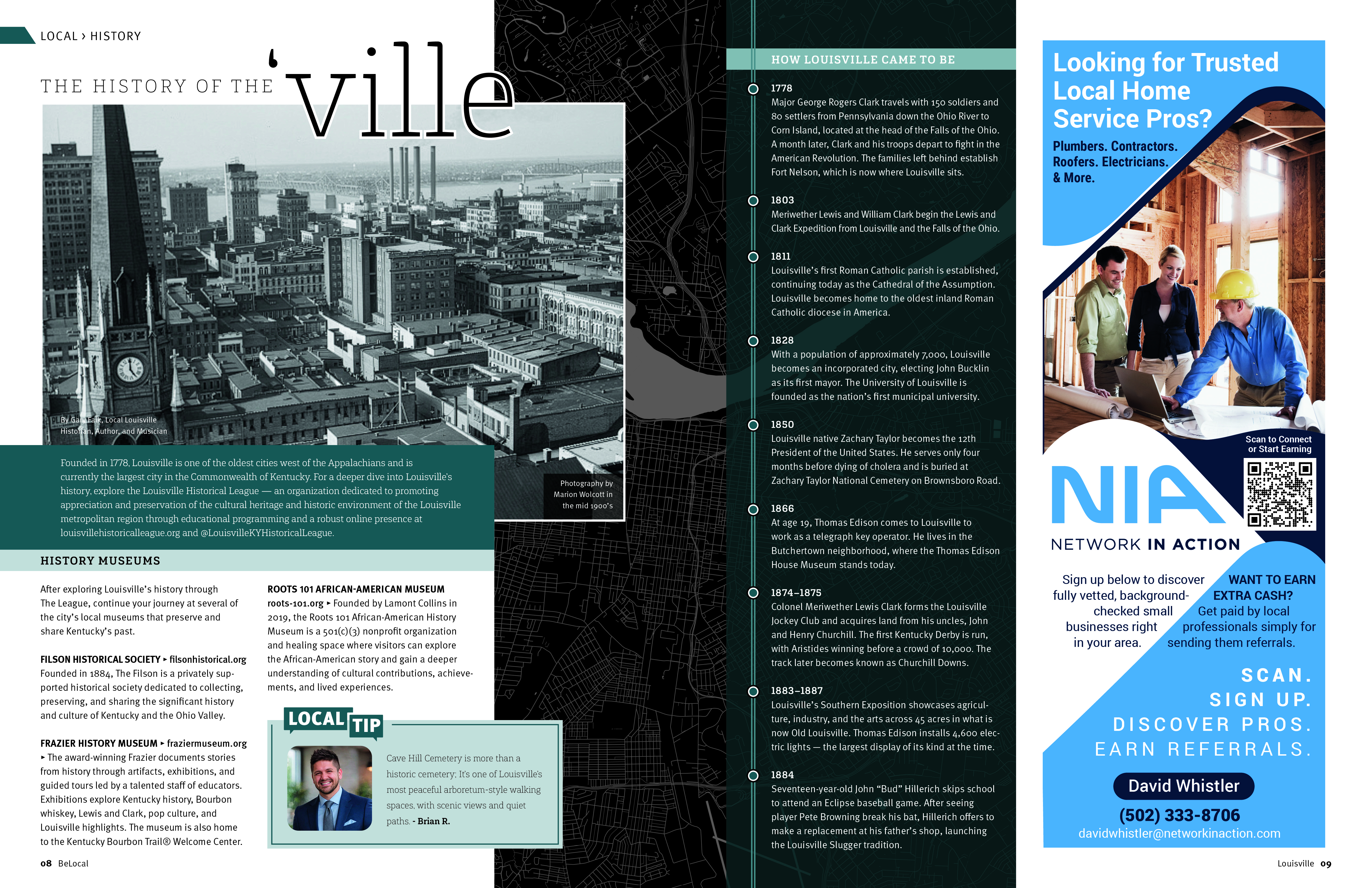
Founded in 1778, Louisville is one of the oldest cities west of the Appalachians and is currently the largest city in the Commonwealth of Kentucky. For a deeper dive into Louisville’s history, explore the Louisville Historical League — an organization dedicated to promoting appreciation and preservation of the cultural heritage and historic environment of the Louisville metropolitan region through educational programming and a robust online presence at louisvillehistoricalleague.org and @LouisvilleKYHistoricalLeague.
History Museums
After exploring Louisville’s history through The League, continue your journey at several of the city’s local museums that preserve and share Kentucky’s past.
Filson Historical Society
filsonhistorical.org
Founded in 1884, The Filson is a privately supported historical society dedicated to collecting, preserving, and sharing the significant history and culture of Kentucky and the Ohio Valley.
filsonhistorical.org
Founded in 1884, The Filson is a privately supported historical society dedicated to collecting, preserving, and sharing the significant history and culture of Kentucky and the Ohio Valley.
Frazier History Museum
fraziermuseum.org
The award-winning Frazier documents stories from history through artifacts, exhibitions, and guided tours led by a talented staff of educators. Exhibitions explore Kentucky history, Bourbon whiskey, Lewis and Clark, pop culture, and Louisville highlights. The museum is also home to the Kentucky Bourbon Trail® Welcome Center.
fraziermuseum.org
The award-winning Frazier documents stories from history through artifacts, exhibitions, and guided tours led by a talented staff of educators. Exhibitions explore Kentucky history, Bourbon whiskey, Lewis and Clark, pop culture, and Louisville highlights. The museum is also home to the Kentucky Bourbon Trail® Welcome Center.
Roots 101 African-American Museum
roots-101.org
Founded by Lamont Collins in 2019, the Roots 101 African-American History Museum is a 501(c)(3) nonprofit organization and healing space where visitors can explore the African-American story and gain a deeper understanding of cultural contributions, achievements, and lived experiences.
roots-101.org
Founded by Lamont Collins in 2019, the Roots 101 African-American History Museum is a 501(c)(3) nonprofit organization and healing space where visitors can explore the African-American story and gain a deeper understanding of cultural contributions, achievements, and lived experiences.
How Louisville Came to Be
1778
Major George Rogers Clark travels with 150 soldiers and 80 settlers from Pennsylvania down the Ohio River to Corn Island, located at the head of the Falls of the Ohio. A month later, Clark and his troops depart to fight in the American Revolution. The families left behind establish Fort Nelson, which is now where Louisville sits.
Major George Rogers Clark travels with 150 soldiers and 80 settlers from Pennsylvania down the Ohio River to Corn Island, located at the head of the Falls of the Ohio. A month later, Clark and his troops depart to fight in the American Revolution. The families left behind establish Fort Nelson, which is now where Louisville sits.
1803
Meriwether Lewis and William Clark begin the Lewis and Clark Expedition from Louisville and the Falls of the Ohio.
Meriwether Lewis and William Clark begin the Lewis and Clark Expedition from Louisville and the Falls of the Ohio.
1811
Louisville’s first Roman Catholic parish is established, continuing today as the Cathedral of the Assumption. Louisville becomes home to the oldest inland Roman Catholic diocese in America.
Louisville’s first Roman Catholic parish is established, continuing today as the Cathedral of the Assumption. Louisville becomes home to the oldest inland Roman Catholic diocese in America.
1828
With a population of approximately 7,000, Louisville becomes an incorporated city, electing John Bucklin as its first mayor. The University of Louisville is founded as the nation’s first municipal university.
With a population of approximately 7,000, Louisville becomes an incorporated city, electing John Bucklin as its first mayor. The University of Louisville is founded as the nation’s first municipal university.
1850
Louisville native Zachary Taylor becomes the 12th President of the United States. He serves only four months before dying of cholera and is buried at Zachary Taylor National Cemetery on Brownsboro Road.
Louisville native Zachary Taylor becomes the 12th President of the United States. He serves only four months before dying of cholera and is buried at Zachary Taylor National Cemetery on Brownsboro Road.
1866
At age 19, Thomas Edison comes to Louisville to work as a telegraph key operator. He lives in the Butchertown neighborhood, where the Thomas Edison House Museum stands today.
At age 19, Thomas Edison comes to Louisville to work as a telegraph key operator. He lives in the Butchertown neighborhood, where the Thomas Edison House Museum stands today.
1874–1875
Colonel Meriwether Lewis Clark forms the Louisville Jockey Club and acquires land from his uncles, John and Henry Churchill. The first Kentucky Derby is run, with Aristides winning before a crowd of 10,000. The track later becomes known as Churchill Downs.
Colonel Meriwether Lewis Clark forms the Louisville Jockey Club and acquires land from his uncles, John and Henry Churchill. The first Kentucky Derby is run, with Aristides winning before a crowd of 10,000. The track later becomes known as Churchill Downs.
1883–1887
Louisville’s Southern Exposition showcases agriculture, industry, and the arts across 45 acres in what is now Old Louisville. Thomas Edison installs 4,600 electric lights — the largest display of its kind at the time.
Louisville’s Southern Exposition showcases agriculture, industry, and the arts across 45 acres in what is now Old Louisville. Thomas Edison installs 4,600 electric lights — the largest display of its kind at the time.
1884
Seventeen-year-old John “Bud” Hillerich skips school to attend an Eclipse baseball game. After seeing player Pete Browning break his bat, Hillerich offers to make a replacement at his father’s shop, launching the Louisville Slugger tradition.
Seventeen-year-old John “Bud” Hillerich skips school to attend an Eclipse baseball game. After seeing player Pete Browning break his bat, Hillerich offers to make a replacement at his father’s shop, launching the Louisville Slugger tradition.
1890
Louisville is struck by one of the most destructive storms in its history, known as the “Louisville Cyclone,” due to its widespread damage.
Louisville is struck by one of the most destructive storms in its history, known as the “Louisville Cyclone,” due to its widespread damage.
1916
President Woodrow Wilson appoints Louisville native Louis Brandeis to the U.S. Supreme Court, making him the first Jewish Supreme Court Justice.
President Woodrow Wilson appoints Louisville native Louis Brandeis to the U.S. Supreme Court, making him the first Jewish Supreme Court Justice.
That same year, the Ford Motor Company opens its first Louisville factory. Today, more trucks are produced in Louisville than anywhere else in the world.
1924
F. Scott Fitzgerald writes The Great Gatsby during visits to Louisville’s Seelbach Hotel, drawing inspiration from the city’s bourbon-era glamour and notable figures.
F. Scott Fitzgerald writes The Great Gatsby during visits to Louisville’s Seelbach Hotel, drawing inspiration from the city’s bourbon-era glamour and notable figures.
1937
The Ohio River Great Flood submerges more than 75% of Louisville, surpassing all previous floods in modern history.
The Ohio River Great Flood submerges more than 75% of Louisville, surpassing all previous floods in modern history.
1942
Cassius Clay is born in Louisville. Later known as Muhammad Ali, he becomes one of the greatest boxers of all time. His legacy is preserved at the Muhammad Ali Center in downtown Louisville.
Cassius Clay is born in Louisville. Later known as Muhammad Ali, he becomes one of the greatest boxers of all time. His legacy is preserved at the Muhammad Ali Center in downtown Louisville.
1975
Jefferson County Public Schools are ordered to implement immediate busing to racially integrate schools. Police escort buses amid protests.
Jefferson County Public Schools are ordered to implement immediate busing to racially integrate schools. Police escort buses amid protests.
1981
United Parcel Service (UPS) launches overnight delivery operations with a major hub at Louisville’s airport. Today, it is one of the world’s largest cargo ports.
United Parcel Service (UPS) launches overnight delivery operations with a major hub at Louisville’s airport. Today, it is one of the world’s largest cargo ports.
2000
The governments of Louisville and Jefferson County merge, forming Louisville Metro.